Bells of St. Matthew’s

The Bells of St. Matthew’s: A Historical Overview
Over the years, the bells of St. Matthew’s Church have become a powerful symbol of heritage and unity, significantly influencing both worship and community life. Their history showcases the artistry and craftsmanship of the bell manufacturers who contributed to their legacy, ensuring that the melodies of St. Matthew’s continue to inspire and uplift all who hear them. The story of these bells began in 1843 when the first bell was installed, marking a significant milestone for both the church and the city. This 350-pound bell was cast by the Holbrook Foundry in Massachusetts, making it the first bell in Southport and the third ever in the Northwest Territory. To celebrate its installation in St. Matthew’s tower, town members rang the bell continuously for 24 hours, establishing a tradition that emphasized the deep-rooted connection between the church and its congregation.
![[[File:Bell cast by George H. Holbrook, East Medway, MA, 1841 - Historical Society of Windham County - Newfane, Vermont - DSC08448.JPG|Bell cast by George H. Holbrook, East Medway, MA, 1841 - Historical Society of Windham County - Newfane, Vermont - DSC08448]]](https://stmatthewskenosha.net/wp-content/uploads/2012/09/Bell_cast_by_George_H._Holbrook_East_Medway_MA_1841_-_Historical_Society_of_Windham_County_-_Newfane_Vermont_-_DSC08448.jpg)
George Holbrook Bells
The significance of the Holbrook Foundry extends beyond the mere creation of a bell for St. Matthew’s. Founded in the early 1800s by William Holbrook, the foundry quickly gained acclaim for its superior craftsmanship, producing not only bells but also various musical instruments that resonated throughout communities across the nation. Holbrook’s commitment to quality and artistry transformed the perception of bells, turning them from utilitarian objects into symbols of community spirit and celebration. The sound of a Holbrook bell—like the one at St. Matthew’s—was more than just a call to worship; it served as a melodic thread that connected the community, marking significant events in their lives, from joyous celebrations to solemn moments of reflection.
Menelly Foundry Bells
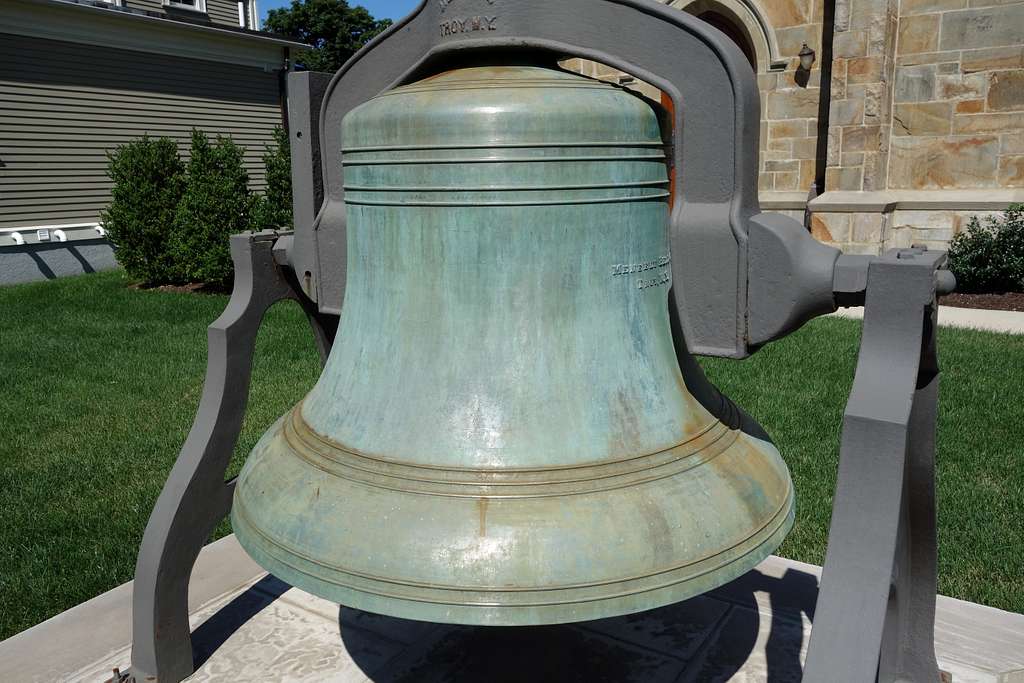
In 1894, the congregation added three Menelly bells from the Menelly Foundry in New York. Weighing 550, 250, and 150 pounds, these bells became an integral part of the church, enriching the community’s auditory landscape by ringing on the hour and quarter-hour, thus marking the passage of time for all who heard their chimes.
The installation of the new bells coincided with the addition of the Seth Thomas Tower Clock, also installed in 1894. This strategic decision reflects the congregation’s desire to synchronize the bell system with the clock, creating a harmonious experience for churchgoers and local residents alike. Together, the clock and bells became significant features of St. Matthew’s, enhancing the church’s architectural beauty and symbolizing the community’s commitment to faith and tradition.

Choir Bells
In 1994, fourteen more bells were added to the church tower, forming a choir of bells. These were cast in Holland and bear the names of individuals memorialized by them. The bells can be played electronically, either by a keyboard or a computer, featuring one octave of notes along with one sharp and one flat.
The evolution of the church’s bells didn’t stop there. The introduction of this choir of bells in 1994 not only expanded the collection but also provided a unique musical experience. This choir stands out not just for its size and sound but also for the names of individuals it memorializes.
Today, the bells and clock serve as a reminder of 19th-century craftsmanship and the enduring spirit of St. Matthew’s Church, fostering a sense of history and continuity in the ever-evolving landscape of Kenosha.